Why the move towards more frequent tax payments could create a significant financial squeeze for taxpayers.
The government has confirmed that, from April 2029, taxpayers who currently make Self Assessment payments on account will be required to pay their tax more regularly throughout the year.
The change is being presented as a way of making tax payments easier to manage, replacing two large instalments with smaller, more frequent payments.
However, there is an important consequence which may not be immediately apparent: taxpayers will have to pay their tax substantially earlier than they do at present.
Although the total amount of tax will not increase, the change represents a potentially significant loss of cash-flow flexibility.
How the present system works
Under the existing system, Self Assessment taxpayers generally make two payments on account each year:
- 31 January – 50% of their estimated annual liability.
- 31 July – the remaining 50%.
These payments are normally calculated using the previous year’s tax liability. Any balancing adjustment is made the following January.
Consider someone whose annual Self Assessment tax liability remains constant at £10,000.
Under the present system, they pay £5,000 on 31 January and £5,000 on 31 July.
The interesting feature is the timing. The January instalment falls approximately two months before the end of the relevant tax year, while the July instalment falls approximately four months afterwards.
The average payment date therefore falls roughly one month after the end of the tax year.
What changes in April 2029?
Under the new arrangements, taxpayers will make payments during the year in which they earn the income.
The precise frequency has not yet been determined. Monthly and quarterly payments have both been considered, and HMRC expects to publish further details during 2027.
For illustration, assume the £10,000 annual liability is divided into 12 monthly instalments of approximately £833.33, beginning in April 2029.
Instead of the average payment falling just after the end of the tax year, it would fall around the middle of the tax year.
That represents a shift of approximately seven months in the average payment date.
In effect, taxpayers would lose around seven months of the cash-flow advantage available under the existing system.
The particular problem in 2029–2030
The first year of the new arrangements will be especially important because taxpayers will still be completing their obligations under the old system while beginning payments under the new one.
Someone with a constant annual liability of £10,000 would still have to pay:
- £5,000 on 31 January 2029.
- £5,000 on 31 July 2029.
At the same time, assuming monthly payments are adopted, they would begin paying approximately £833 each month towards their 2029–2030 tax liability.
This creates a period of overlapping payments.
Under the existing system, the total paid between 31 January 2029 and 31 March 2030 would be £15,000.
Under the illustrative new arrangement, that figure increases to £20,000.
At the end of December 2029, the cumulative difference would be even greater: £17,500 paid under the new arrangement compared with £10,000 under the existing one.
That is an additional £7,500 which the taxpayer would have had to find by that point.
The cash-flow effect illustrated
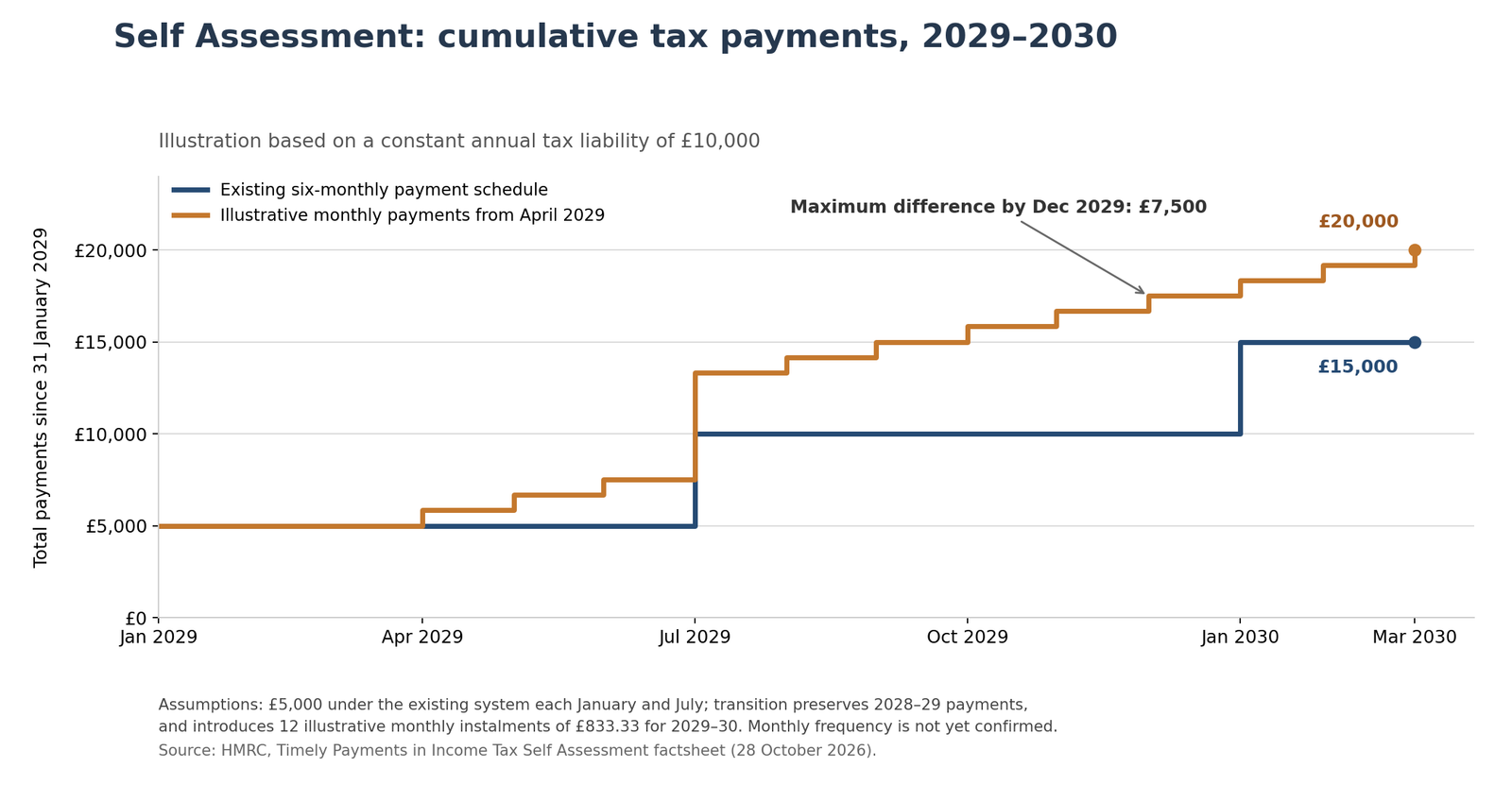
The chart shows how cumulative payments increase under the two systems. The existing arrangement produces distinct jumps in January and July, while the illustrative new arrangement adds regular monthly payments.
The greatest difference occurs during the transition, when the taxpayer is paying towards two successive tax years simultaneously.
It is important to emphasise that this is not additional taxation. The same liability is simply being collected earlier.
Nevertheless, money paid to HMRC earlier is money no longer available for working capital, savings or investment.
Who will be affected?
The changes are not confined to self-employed individuals.
They will apply to Self Assessment taxpayers who are required to make payments on account. This can include individuals receiving rental income, dividends or savings income, as well as trading profits.
Those whose Self Assessment liabilities are below £1,000, or who already pay more than 80% of their tax outside Self Assessment, are generally excluded from the payments-on-account system.
Taxpayers with sufficient PAYE income will also have the option of making their payments through PAYE.
What should taxpayers do?
Although implementation is still more than two years away, it would be sensible to begin considering the cash-flow implications.
For taxpayers with substantial annual liabilities, the transition could require several thousand pounds of additional liquidity during 2029.
HMRC has acknowledged these concerns and intends to develop measures to support taxpayers through the change. The precise transitional arrangements have not yet been finalised.
Conclusion
More frequent tax payments may make budgeting easier for some taxpayers, but the underlying financial consequence should not be overlooked.
The government is not increasing the tax liability through this reform. It is accelerating the collection of tax.
For taxpayers accustomed to the existing January and July arrangements, the change will mean giving up a valuable period during which they currently retain the use of their money.
The transition in 2029–2030 is likely to be the most difficult period, and advance planning will be essential.
This article reflects government announcements as at November 2026. The illustrated monthly payment schedule is an example, not a confirmed HMRC timetable.