For many years, operating through a limited company was widely regarded as the most tax-efficient way to run a small business. But changes in taxation have altered that position, and the self-employed business owner may now be better off.
The traditional limited company approach
For many years, the conventional approach for an owner-managed limited company has been to pay the director a relatively modest salary, traditionally equal to the personal allowance of £12,570, and then take the remaining profits as dividends.
The company pays Corporation Tax on its profits, while the shareholder pays Income Tax on dividends received. Dividends are not subject to National Insurance.
This combination has historically offered a tax advantage over operating as a sole trader.
However, increases in Corporation Tax, dividend taxation and employer’s National Insurance have progressively reduced that advantage.
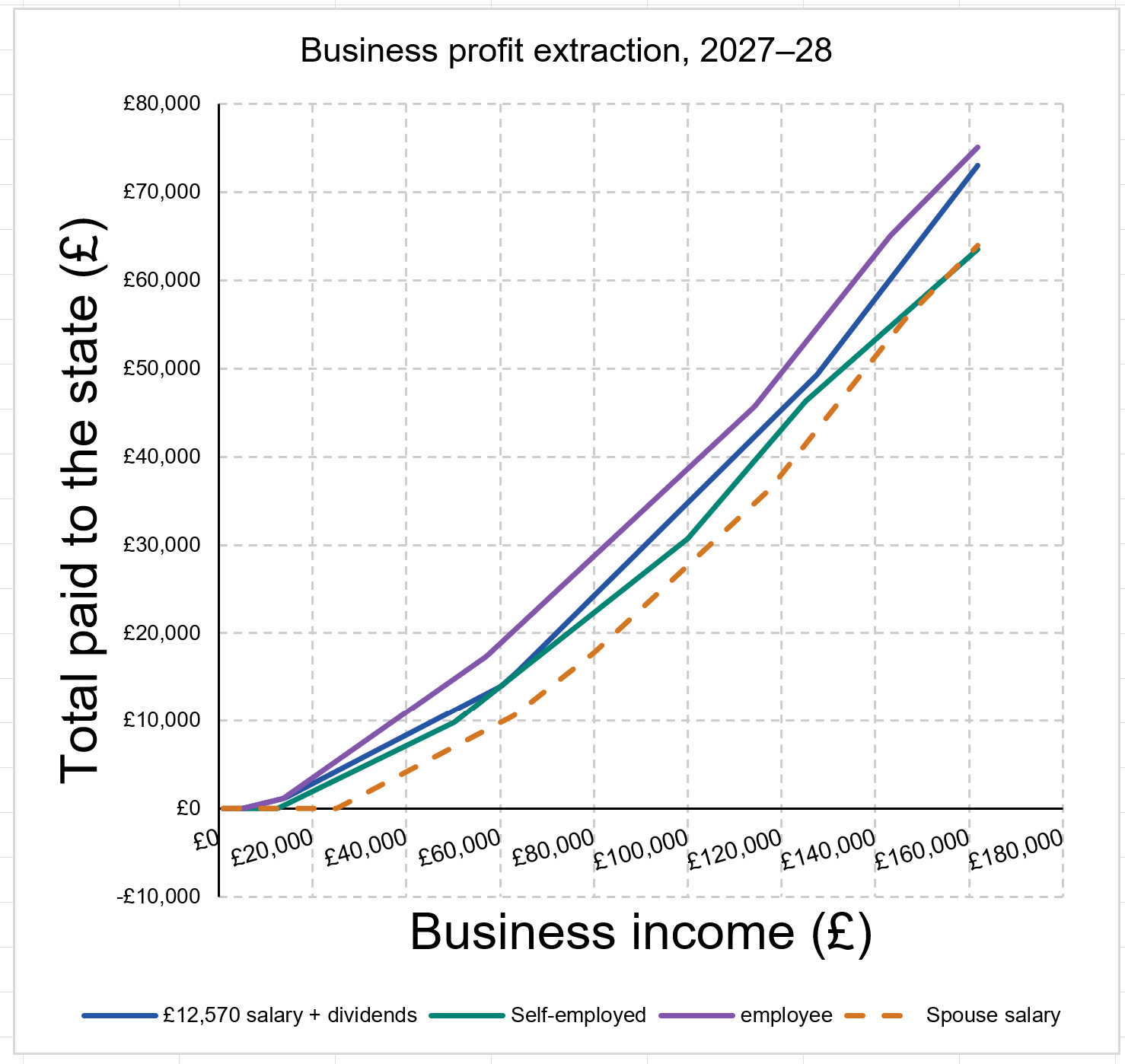
The position for the 2027–28 tax year is illustrated in the following graph.
What the graph shows
The graph compares the total amount paid to the state through Income Tax, Corporation Tax and National Insurance at different levels of business income.
Four different arrangements are illustrated:
- Blue line – A limited company paying its director a salary of £12,570, with the remaining distributable profits taken as dividends.
- Green line – A self-employed individual operating as a sole trader.
- Purple line – A limited company extracting its profits through salary and bonus rather than dividends.
- Orange dashed line – A business employing the owner’s spouse at a salary of £12,570.
The lower the line, the less tax and National Insurance is paid.
Self-employment is now frequently more tax-efficient
Perhaps the most interesting feature of the graph is that the green line, representing self-employment, is generally below the blue line representing the traditional limited company arrangement.
At approximately £60,000 of business income, the two structures produce broadly similar overall tax liabilities.
At most other income levels shown, the self-employed individual pays less tax and National Insurance than the company owner using the salary-and-dividend approach.
This has not always been the case. Historically, the limited company structure frequently produced worthwhile tax savings.
One reason for the change is the reduction in Class 4 National Insurance for the self-employed. For 2027–28, the rate is 6% on profits between £12,570 and £50,270 and just 2% on profits above that level.
By comparison, the limited company route involves Corporation Tax, dividend taxation and potentially employer’s National Insurance on the director’s salary.
The combined effect has substantially narrowed, and in many cases reversed, the traditional tax advantage of incorporation.
Taking everything as salary is generally the least attractive option
The purple line represents the situation where the business owner extracts the profits through salary and bonus rather than dividends.
This produces the highest overall tax burden of the principal arrangements illustrated.
A major reason is employer’s National Insurance, charged at 15% on earnings above the relevant threshold, together with the Income Tax and employee National Insurance payable by the individual.
Although salary and employer’s National Insurance are normally deductible when calculating the company’s Corporation Tax liability, the overall burden remains comparatively high.
For the circumstances illustrated, extracting all company profits as salary and bonus is unattractive from a tax perspective. A family company with Employment Allowance available can produce a different result, as the salary comparison below explains.
Employing a spouse can produce useful savings
The orange dashed line illustrates the potential benefit of employing a spouse at an annual salary of £12,570.
Where the spouse has no other taxable income, this salary can make use of their personal allowance, while the payment is a deductible business expense, provided it represents reasonable remuneration for genuine work.
For a small family business, this can produce a meaningful reduction in the overall tax burden.
There is, however, an important qualification. The spouse must genuinely undertake work for the business, and the remuneration should be commercially reasonable in relation to those duties.
Examples might include bookkeeping, administration, customer correspondence, purchasing or other routine business activities.
An additional benefit may arise where the business operates through a limited company.
For 2027–28, eligible employers can claim Employment Allowance of up to £10,500 annually against their employer’s National Insurance contributions.
A company with only one director, where that director is the sole employee giving rise to employer’s National Insurance, is generally excluded from claiming this allowance.
However, employing an additional person, potentially the director’s spouse, at remuneration above the employer’s National Insurance secondary threshold can make the company eligible.
This can be particularly valuable because the allowance may then offset employer’s National Insurance on both the director’s and the spouse’s salaries, subject to the overall £10,500 limit.
Consequently, employing a spouse can provide two financial advantages: the salary reduces taxable business profits and, where the qualifying conditions are satisfied, it can make Employment Allowance available to the company.
The illustration assumes that the spouse has no other earnings. However, even where the spouse has another source of income and has already used their personal allowance, paying a commercially justified salary may still produce an overall tax saving. The benefit will depend on the spouse’s marginal tax rate and the circumstances of the business.
This possibility can make employing a spouse a particularly attractive arrangement for a small owner-managed business.
How much salary should a husband-and-wife company pay?
Where both spouses genuinely work in the company, neither has other income and Employment Allowance is available, a salary of £12,570 each is a useful starting point. Further drawings can then be taken as dividends, unless a calculation of the full year’s position shows that a larger salary or bonus produces a better result.
The aim is to maximise the couple’s net income after all taxes, rather than to use every pound of an allowance.
Unused Employment Allowance does not necessarily mean a missed saving
At salaries of £12,570 each, employer’s National Insurance before Employment Allowance is £2,271: two lots of (£12,570 − £5,000) × 15%. The allowance covers this in full, leaving £8,229 available against further employer NI.
With the wife’s salary fixed at £12,570 and no other employees, the husband’s salary could rise to £67,430 before the £10,500 allowance is fully used. This is a limit for employer NI relief, not a recommended salary. The company would need at least £80,000 of profit before these salaries to fund them, leaving nothing for dividends at that level.
Extra salary reduces Corporation Tax, but it also creates Income Tax and employee NI. It uses the husband’s basic-rate band before dividends, potentially pushing some dividends into a higher tax band. Employee NI on additional salary falls from 8% to 2% above £50,270, while the withdrawal of Personal Allowance above £100,000 of adjusted net income can change the result again.
A short comparison
The examples below compare two salary policies. In both, the wife receives £12,570 and all remaining post-tax company profit is paid to the husband as dividends. The figures are the couple’s combined net annual income, rounded to the nearest pound.
| Profit before both salaries | Husband’s salary £12,570 | Husband’s salary £67,430 | Effect of higher salary |
|---|---|---|---|
| £100,000 | £72,380 | £72,824 | £444 better |
| £125,000 | £84,186 | £85,059 | £873 better |
| £150,000 | £94,171 | £93,356 | £815 worse |
A modest salary increase is not necessarily a stepping stone to a better result. At £100,000 of company profit, a husband’s salary of £50,270 gives combined net income of approximately £71,802, less than the £72,380 obtained with a £12,570 salary.
A practical way to decide
- Set commercially justified salaries, using available Personal Allowances where appropriate.
- Once expected annual profit is reasonably clear, compare the existing salary-and-dividend arrangement with a larger bonus, calculating Corporation Tax, both spouses’ personal taxes and NI together.
- Pay the bonus only if it improves the overall result. Leaving some Employment Allowance unused can be the better choice.
The table compares two specified policies; it does not establish the best salary at every profit level. Higher profits may justify testing salaries beyond the Employment Allowance limit as well.
These calculations assume 2027–28 rates for England, Wales or Northern Ireland, both spouses below State Pension age, no other income or pension contributions, no other employees or associated companies, a 12-month company accounting period and salaries fully deductible for Corporation Tax. They include marginal relief, the £500 dividend allowance and the Personal Allowance taper. Other income, age or retained profits require a fresh calculation.
The graph above compares its stated arrangements; it does not select the most tax-efficient salary for each profit level. The family-company examples here are a separate comparison with Employment Allowance available.
Sources: GOV.UK rates and allowances for 2027–28; Employment Allowance eligibility; Corporation Tax rates. Illustrative calculations by Steve Watt Associates.
An important distinction: what happens to profits that are not withdrawn?
The graph assumes that the business owner extracts the profits rather than leaving them in the business.
This highlights a fundamental difference between a sole trader and a limited company.
A self-employed individual is taxed on the full profits of the business, regardless of how much money is actually withdrawn for personal use.
By contrast, a limited company is a separate legal entity. It pays Corporation Tax on its profits, but the shareholder does not normally incur personal dividend taxation until dividends are actually paid.
Consequently, the owner of a profitable company who does not need to withdraw all the profits may benefit from leaving money in the company for reinvestment or future distribution.
The company structure can therefore offer greater flexibility over the timing of personal taxation, even where the overall tax cost of extracting all profits is higher.
Other advantages and disadvantages
Tax is not the only consideration when deciding whether to operate as a sole trader or through a limited company.
A limited company offers the benefit of limited liability, subject to exceptions such as personal guarantees and certain directors’ liabilities. It can also provide a useful structure for bringing additional shareholders into the business or retaining profits for expansion.
However, a company has additional administrative and compliance obligations, including statutory accounts, Corporation Tax returns, Companies House filings and potentially payroll and dividend administration.
These obligations normally involve additional professional fees and management time.
A sole trader has a simpler structure, with fewer statutory formalities and generally lower administration costs.
On the other hand, the sole trader is personally responsible for the liabilities of the business, and the full annual profit is subject to personal taxation whether or not it is withdrawn.
Conclusion
The assumption that operating through a limited company automatically produces tax savings is now outdated.
For the 2027–28 tax year, self-employment can be more tax-efficient than the traditional limited company arrangement where all profits are extracted.
For a family business, employing a spouse who genuinely undertakes business duties can improve the position further.
In the case of a limited company, this may also make Employment Allowance available, producing further savings in employer’s National Insurance.
Nevertheless, a limited company may remain advantageous where profits are retained for future investment, where limited liability is important, or where there are other commercial reasons for incorporation.
The choice should therefore be based on the circumstances of the individual business, rather than simply following the traditional assumption that a limited company must be better.
The graph is an illustrative comparison based on the 2027–28 tax rules. Actual liabilities depend on individual circumstances, other income, reliefs, Employment Allowance eligibility and the amount of profit withdrawn.